
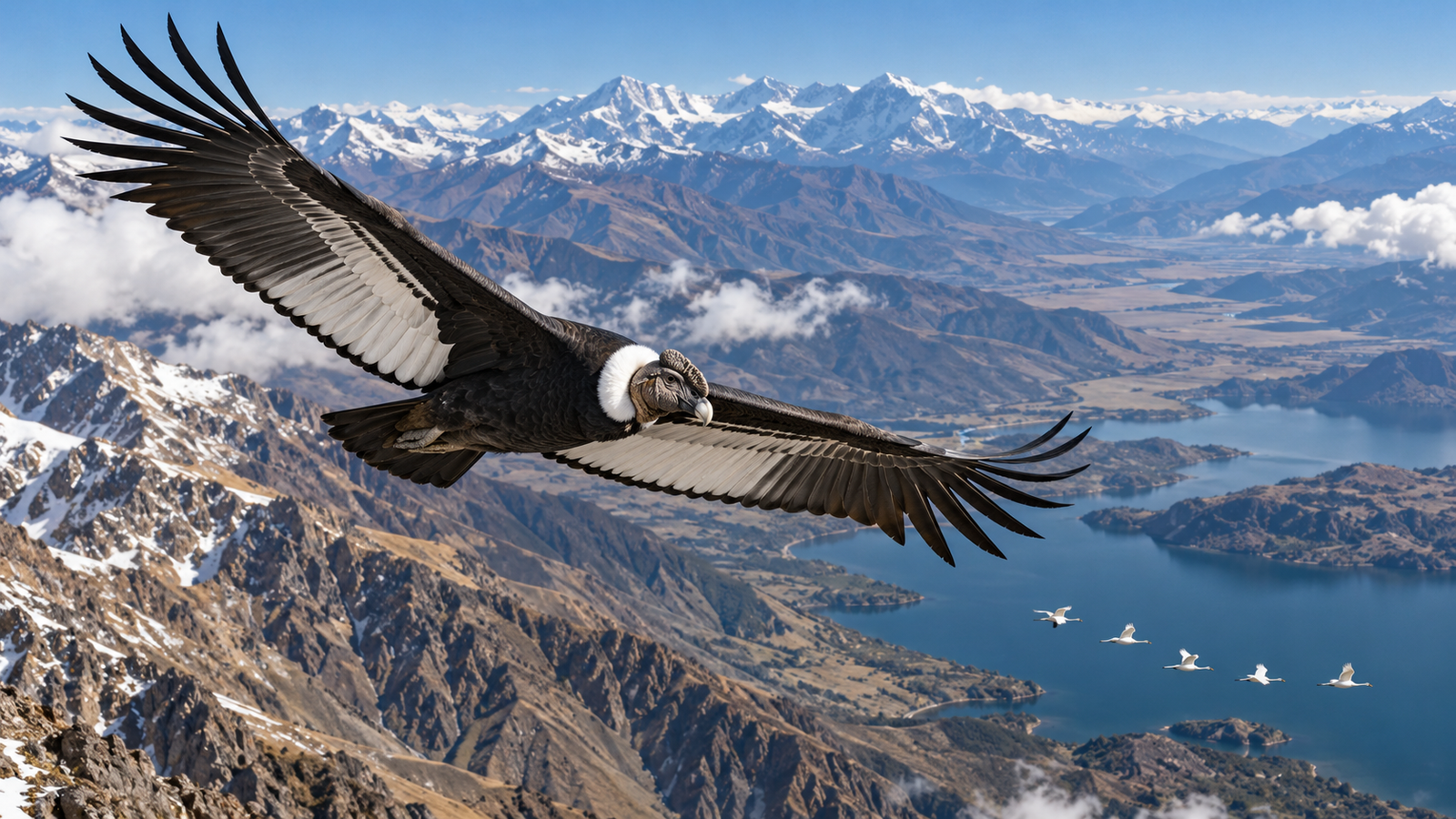
WWATV AI-generated editorial illustration—not documentary photography. It visualizes the exact animal and verified reporting context.
LIVING WORLD DISCOVERY
The Bird That Flies on Free Fuel From the Sky
Vultur gryphus · Research published October 15, 2026
Seventeen years of tracking reveal that an Andean condor can spend 79 percent less energy per kilometer than a similarly heavy trumpeter swan.
Free fuel from the sky
An Andean condor can travel above mountains with wings held almost motionless. A new global analysis published in Science on October 15, 2026, shows that this is more than graceful flight. By riding rising air, a condor can make flying extraordinarily inexpensive.
The study compared an Andean condor and a trumpeter swan that each weigh about 11 kilograms. The condor’s estimated energy cost per kilometer was 79 percent lower. It flapped for about 0.1 percent of its flight time; the swan flapped for about 99 percent.
A textbook rule meets the real sky
Classic laboratory measurements rank swimming as the cheapest way for animals to travel, followed by flying and then running. But wind tunnels and treadmills hold the surrounding environment steady. Wild animals do not move through steady environments.
In nature, the atmosphere supplies both help and resistance. Warm ground can produce columns of rising air called thermals. Mountain slopes can push air upward. Condors circle within that lift to gain altitude, then glide forward while spending very little energy on flapping.
Seventeen years of movement data
Researchers combined 17 years of GPS and accelerometer records from 850 birds and bats representing 38 species. They added four years of radar observations covering 12 size classes of smaller flying animals. In all, the analysis represented 50 species.
GPS showed where an animal traveled. Accelerometers helped separate costly flapping from low-cost soaring. The team matched those movements with wind and rising-air conditions, then estimated energy spent per meter—the biological equivalent of fuel economy.
What seven vulture species revealed
The soaring vultures in the study supplied an extraordinary record: a combined 128,000 days and more than 4.3 million kilometers of flight. Depending on the species, they flapped during only 0.1 to 7 percent of flight time. The heaviest, the Andean condor, flapped least.
Large soaring birds gain enormous benefits when lift is available, but their size can also restrict when and where they fly. A calm morning, a headwind or weak thermals can change the energy budget.
Why weather becomes habitat
The study’s central lesson is that the sky is not empty space. For flying animals, moving air is part of the habitat. If climate change alters winds and thermals, it may also alter the timing, routes and costs of migration.
The estimates are based on movement and atmospheric data rather than direct measurements of every heartbeat. The researchers say future work could add heart-rate monitoring. Even with that limitation, the study offers a powerful new way to predict how the changing atmosphere may reshape animal movement.
Explore Andean condor in Learn & Grow
Reporting credit: Max Planck Institute of Animal Behavior and Science, DOI 10.1126/science.aee6550.