WWATV AI-generated editorial illustration—not a photograph of the reported event or research. It visualizes the exact species and verified story context without claiming documentary evidence.
ANIMAL RESEARCH SPOTLIGHT
When Artificial Intelligence Works for Rangers—not Instead of Them
Mesembriomys gouldii · Research published in 2026; institutional feature October 13, 2026
Camera traps created almost one million images. AI reduced the first-pass workload by more than 81 percent, while Traditional Owners and rangers retained the essential work of verification, interpretation and governance.
A nocturnal animal leaves a mountain of evidence
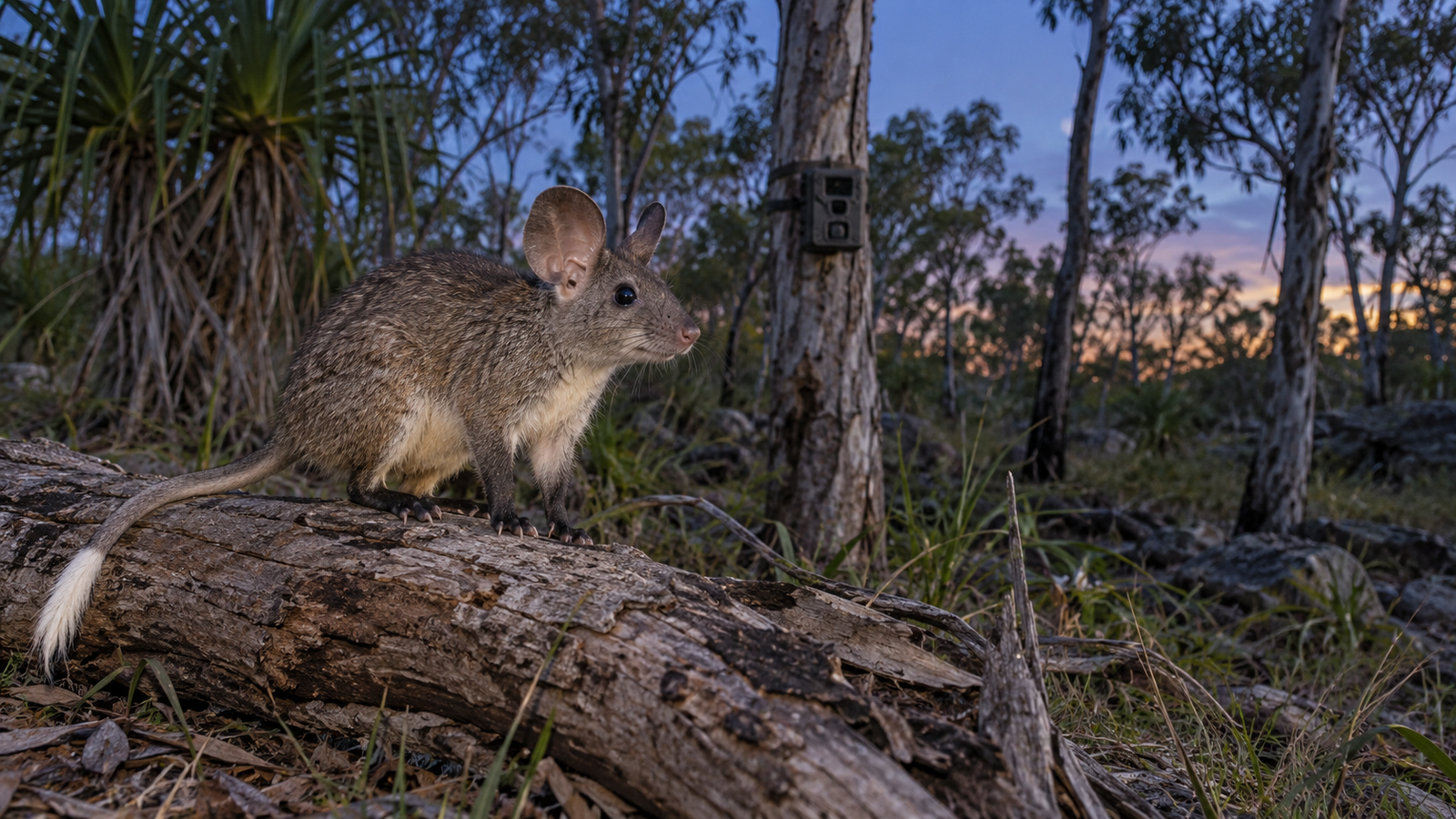
A black-footed tree-rat steps into the invisible beam of a camera trap in West Arnhem Land. The camera wakes, records the animal and waits. Over months and years, many cameras repeat that simple action until the project holds hundreds of thousands of images: animals, people, shadows, moving leaves and empty frames triggered by heat or motion.
The black-footed tree-rat, Mesembriomys gouldii, is one of Australia’s largest native rodents. It has large ears, a shaggy grey-brown coat, dark hind feet and a long tail ending in a pale brush. In northern Australia it lives in woodland and forest, shelters in hollows or dense vegetation by day, and emerges at night to feed.
Images of animals like this tree-rat help Warddeken rangers understand what lives across the Warddeken Indigenous Protected Area and how land-management practices affect species of cultural and conservation concern. But collecting photographs is only the first step. Someone must still find the meaningful frames, identify what they show, check the records and turn observations into information that can guide care for Country.
The research question was bigger than speed
Artificial intelligence can sort camera-trap photographs faster than people working image by image. The easy question is therefore: how many hours can a computer save?
The Warddeken collaboration asked a harder question: how can AI support Indigenous-led wildlife monitoring without taking control of the work, weakening cultural authority, removing jobs, or sending sensitive knowledge into systems the community does not govern?
Warddeken Land Management, Charles Darwin University and CSIRO worked through that problem within the Mayh wildlife program. “Mayh” refers to animals in Bininj Kunwok. The program uses motion-activated cameras and employs Traditional Owners and rangers in monitoring, image processing, species identification, reporting and decision-making.
Before AI became part of the workflow, the collaboration negotiated its purpose and safeguards. Traditional Owners helped determine who should participate and how information should be handled. A research agreement protected Indigenous cultural and intellectual property and recognized Warddeken data sovereignty. Free, prior and informed consent was treated as an ongoing process rather than a one-time signature.
What the equipment actually did
Camera traps collected the raw evidence across the protected area. The AI system, MegaDetector, did not write the final ecological story or replace species experts. Its first job was triage: identify frames likely to contain an animal, person or vehicle so rangers did not spend equal time opening every wind-triggered image.
In the reported trial, the model processed material representing 1,572 hours of ranger-collected data. It reduced the image set requiring human analysis from 925,088 photographs to 172,290—an 81.4 percent reduction. The reported processing period fell from six months to two months, while average processing time declined from 52.6 to 41.8 hours per fortnight.
Those numbers describe filtering and workflow, not flawless automated identification. People remained part of verification. Rangers checked images, applied local and species knowledge, and decided how information would enter their stewardship system. This human step matters because AI can miss rare animals, confuse similar species, or perform poorly when a new landscape looks different from its training data.
From photographs to “strong data”
The project did not judge success only by the number of images deleted from a queue. Researchers followed how the new workflow affected work, skills and community goals.
From July 2021 through January 2023, 68 rangers—60 daluk and eight bininj—recorded time spent processing images and described changing digital practices. Focus groups were held at three outstations with 15 daluk rangers and five non-Indigenous staff. Seven semi-structured interviews followed in February 2023, conducted in English or Bininj Kunwok according to participant preference. Senior daluk rangers translated Bininj Kunwok transcripts. A later workshop brought participants together to discuss emerging themes.
The research team used participatory action methods, meaning the people doing the monitoring were not simply subjects being observed from outside. They helped negotiate the tools, interpret the effects and shape the project as it changed.
Warddeken participants described “strong data” as information strengthened by people being part of collection, verification and processing—and by their authority to decide how the results support decisions on Country. The time saved by automated filtering allowed more attention to species identification, language documentation, reports, videos, workshops and knowledge sharing between generations.
The animal must not disappear behind the technology
It would be easy to make AI the hero of this story. That would miss the point.
The camera does not decide which species matter to families. An algorithm does not hold cultural responsibility for a place. A cloud platform cannot replace the knowledge needed to understand fire, seasons, animal relationships and the meaning of a sighting. Technology becomes useful here because rangers and Traditional Owners determine its role.
The black-footed tree-rat makes that principle visible. A computer may help locate the frames in which it appears. People must still verify the animal, place the sighting in context and decide what action follows. On the mainland Northern Territory, the black-footed tree-rat is listed as endangered; the Melville Island subspecies is listed as vulnerable. Monitoring has real stakes, but a faster image pipeline is not automatically a conservation outcome.
What the research does not prove
This case study does not prove that one AI model will work equally well for every species, habitat or Indigenous community. It does not show that automation can safely remove human review. It does not turn private monitoring data into an open resource; the research states that some supporting data are restricted because public release could compromise participant privacy.
Instead, the study offers a model for asking better questions before conservation technology is scaled. Who defines the purpose? Who owns the data? Which knowledge can be shared? Who verifies the output? Who receives the benefit? What happens when the model is wrong?
For Wild Wonders Animal TV, that is the most exciting part. The future of wildlife research is not simply more cameras and larger models. It is better relationships between animals, place, technology and the people responsible for all three.
Explore Black-footed tree-rat in Learn & Grow
Exact-species live encyclopedia entry verified October 14, 2026.
Reporting credit: Reporting based on the peer-reviewed Mayh wildlife-program paper, Charles Darwin University, Northern Territory species information and accepted taxonomy.