
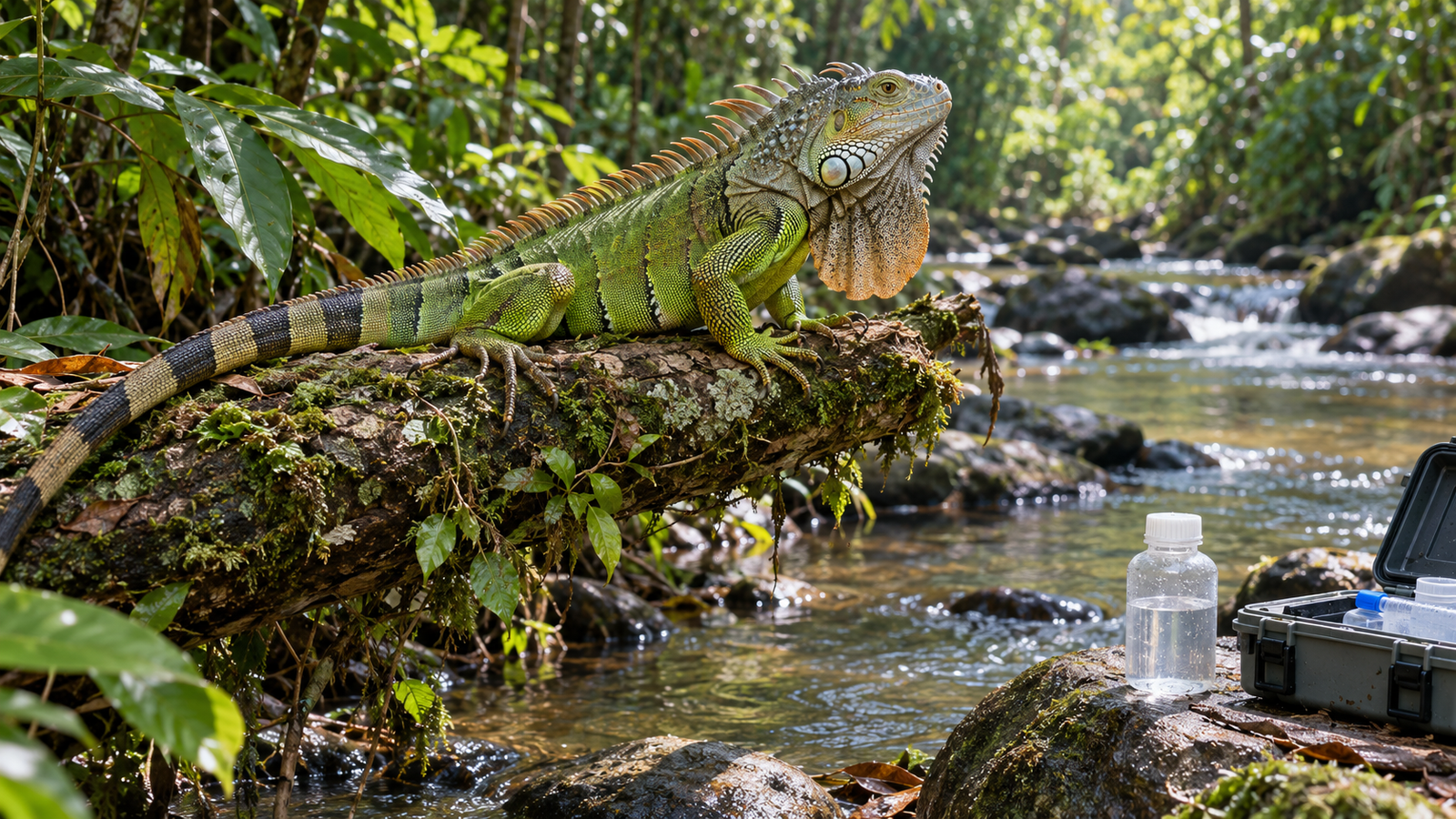
WWATV AI-generated editorial illustration—not documentary photography. It visualizes the exact animal and verified reporting context.
ANIMAL RESEARCH SPOTLIGHT
The Iguana Found in a Bottle of Water
Iguana iguana · Institutional report published October 14, 2026
A tropical stream sample held genetic traces of an animal nobody had to catch or even see—showing how environmental DNA can expose hidden wildlife.
An animal found without being seen
During Curtin Malaysia’s first Global BioBlitz, a water sample carried an unexpected clue: DNA from a common green iguana. No researcher needed to catch the reptile or even photograph it. The animal had left microscopic genetic traces in its environment.
Curtin University reported the result on October 14, 2026. Because the green iguana is not native to Sarawak, the detection is more than a surprising campus record. It demonstrates how environmental DNA can reveal wildlife that ordinary observation may miss.
What environmental DNA is
Animals constantly leave biological material behind: shed skin cells, mucus, waste, scales and tiny fragments of tissue. In water or soil, researchers can collect this material and search it for genetic sequences.
The method is called environmental DNA, or eDNA. It does not prove the exact number, age or health of the animals present. A positive result must be checked carefully for contamination and interpreted with local knowledge. But it can provide an early signal that a species may be nearby.
From stream bottle to sequence
Researchers begin with sterile collection equipment and carefully documented sampling locations. Water is filtered so biological particles remain on a membrane. DNA is extracted, copied and sequenced. Computer tools compare the recovered sequences with reference libraries to find likely species matches.
Controls are essential. Blank samples help reveal contamination. Replicate samples show whether a signal can be repeated. A match can then guide follow-up surveys using cameras, direct searches or additional water samples.
A worldwide BioBlitz
More than 100 students and researchers participated across Curtin campuses in Malaysia, Singapore and Perth. Their analysis found 572 unique species among 26,572 distinct DNA sequences, creating a biodiversity baseline that can be compared with future results.
The green iguana signal shows both the power and the caution of the method. It is a clue, not a complete population survey. Investigators still need to determine whether the DNA came from an established free-living animal, a recent release or another source.
Why this matters for wildlife
Early detection is especially valuable for introduced species. A population that is small and localized may be easier to investigate or manage than one discovered only after it spreads widely.
For viewers, eDNA changes the meaning of a quiet stream. Water is not just habitat; it can be a moving biological record. With careful sampling, transparent controls and responsible interpretation, researchers can ask an ecosystem which animals have passed through—even when the animals themselves remain hidden.
Explore Common green iguana in Learn & Grow
Reporting credit: Curtin University Malaysia Global BioBlitz report, October 14, 2026.