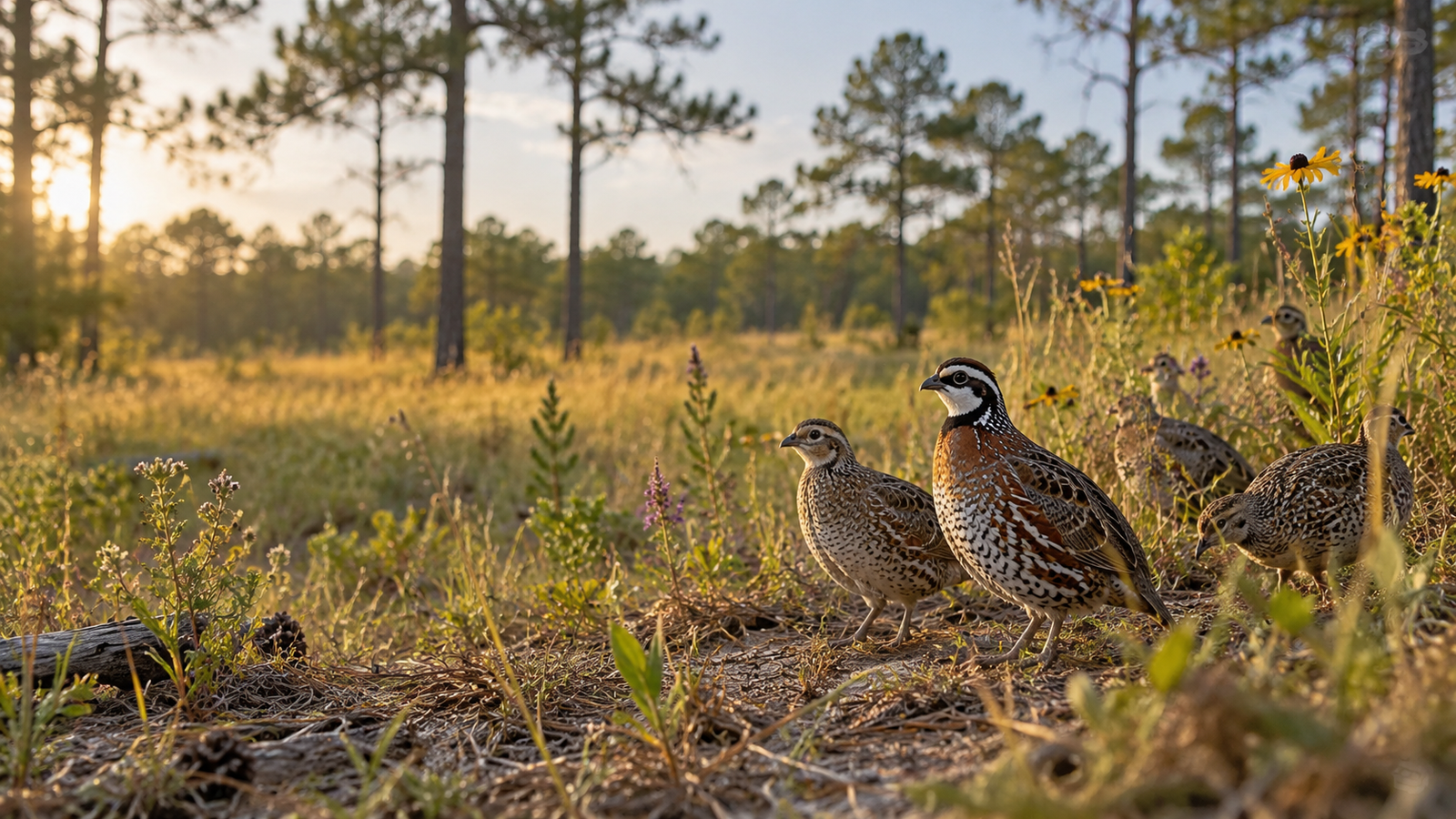
WWATV AI-generated editorial illustration—not a photograph of the reported event or research. It visualizes the exact species and verified story context without claiming documentary evidence.
HABITAT & RECOVERY WATCH
A Wild Whistle Returns to a Tennessee Savanna
Colinus virginianus · Institutional report published October 13, 2026
Multiple wild coveys are using a Tennessee landscape where thinning, mulching and prescribed fire are rebuilding the open habitat bobwhites need. It is a promising sign—not yet proof of a fully recovered population.
A small bird and a very large repair job
The return was not announced by a ribbon cutting or a release cage. It arrived as wild birds moving through a landscape that people had begun to reshape for them.
Multiple coveys of northern bobwhite were recently observed at the University of Tennessee’s Ames AgResearch and Education Center. The sighting is an encouraging milestone in a restoration project working across more than 5,000 acres of historic field-trial grounds. But the most important part of this story is not that several groups of birds appeared. It is the habitat work that made their appearance possible.
Northern bobwhites are compact ground-dwelling birds of grasslands, open woodland and early-successional habitat. Their famous “bob-WHITE!” whistle once carried widely across much of the eastern United States. They need a patchwork rather than a single uniform field: clumps of bunchgrass for nesting, overhead cover for protection, open ground beneath vegetation so chicks can move and feed, and shrubby edges for escape from weather and predators.
When a landscape becomes a wall of dense trees or a carpet of unsuitable groundcover, that patchwork disappears. A place can still look green to people and be nearly unusable to a bobwhite.
Restoration begins by letting in light
The Ames project is in the second year of a partnership between UT AgResearch and Tall Timbers, an organization specializing in fire ecology and wildlife management. Since work began in 2025, teams have managed about 1,500 acres through tree thinning, mulching and prescribed fire.
Each tool changes the structure of the land. Thinning reduces closed canopy and allows more sunlight to reach the ground. Mulching helps remove dense woody material. Prescribed fire resets vegetation under carefully planned conditions, encouraging the grasses, wildflowers and open structure associated with savanna habitat.
Fire can sound destructive, especially when wildfire images dominate public attention. Prescribed fire is different. Trained teams burn selected areas under a plan that considers weather, fuel conditions, smoke and safety. In ecosystems that evolved with recurring fire, well-managed burns can help prevent woody plants from closing every opening and can renew a varied ground layer used by bobwhites and many other animals.
Long-term plans at Ames include annual prescribed burns across approximately half of the field-trial courses. Managers also expect to control invasive or otherwise undesirable plants, provide supplemental winter feed, and use targeted predator management during the summer nesting season.
Why pen-raised birds are not the answer
The Ames grounds have a long history with bird-dog competitions. Because wild quail numbers became too low to support those events, pen-raised birds have been released for competitions. Those releases should not be confused with restoring a self-sustaining wild population.
Animals raised in captivity may not possess the same survival experience as wild birds, and placing birds into poor habitat does not repair the reason a population declined. The restoration team’s central argument is that thousands of acres must first become suitable for nesting, feeding, hiding and raising young.
Where remaining wild populations are too small to respond on their own, the project may use translocation—moving wild birds from another population—as part of a multiyear recovery effort. That step will require careful source-population decisions, health safeguards, release planning and follow-up monitoring. Moving birds can accelerate recolonization, but only if the restored landscape can support them after release.
What the new sighting does—and does not—prove
Seeing multiple wild coveys is meaningful. A covey is a social group of quail, often formed outside the breeding season. Several coveys indicate that wild birds are using the property rather than a single individual merely passing through.
Still, one season’s observation does not establish a recovered population. Researchers and managers will need repeated surveys to learn whether numbers grow, whether birds survive through winter, where they nest, how many chicks fledge, and whether the habitat work creates stable conditions over time.
The restoration timeline also depends on weather, costs and timber markets. Habitat work across thousands of acres cannot be finished instantly. Even after the initial transformation, savannas require continuing management. Without recurring disturbance, woody growth can slowly close the open structure again.
A bird that can carry an ecosystem story
Bobwhites are often called an umbrella species because managing for their needs can benefit a wider community. Open savannas and diverse ground vegetation can support pollinators, songbirds, reptiles, small mammals and native plants. That does not mean every practice helps every species in every place. It means bobwhite habitat management can create structural variety that many declining open-land animals also need.
The project therefore offers a useful way to understand restoration. Conservation is not always about placing an endangered animal behind a fence. Sometimes it is about rebuilding the processes—the sunlight, fire pattern, plant diversity and connected cover—that allow wildlife to choose a place again.
The wild coveys at Ames are not the end of the story. They are an early answer from the landscape: some of the work is beginning to look like home.
Explore Northern bobwhite in Learn & Grow
Exact-species live encyclopedia entry verified October 14, 2026.
Reporting credit: Reporting based on the University of Tennessee Institute of Agriculture project update and its documented restoration plan.