
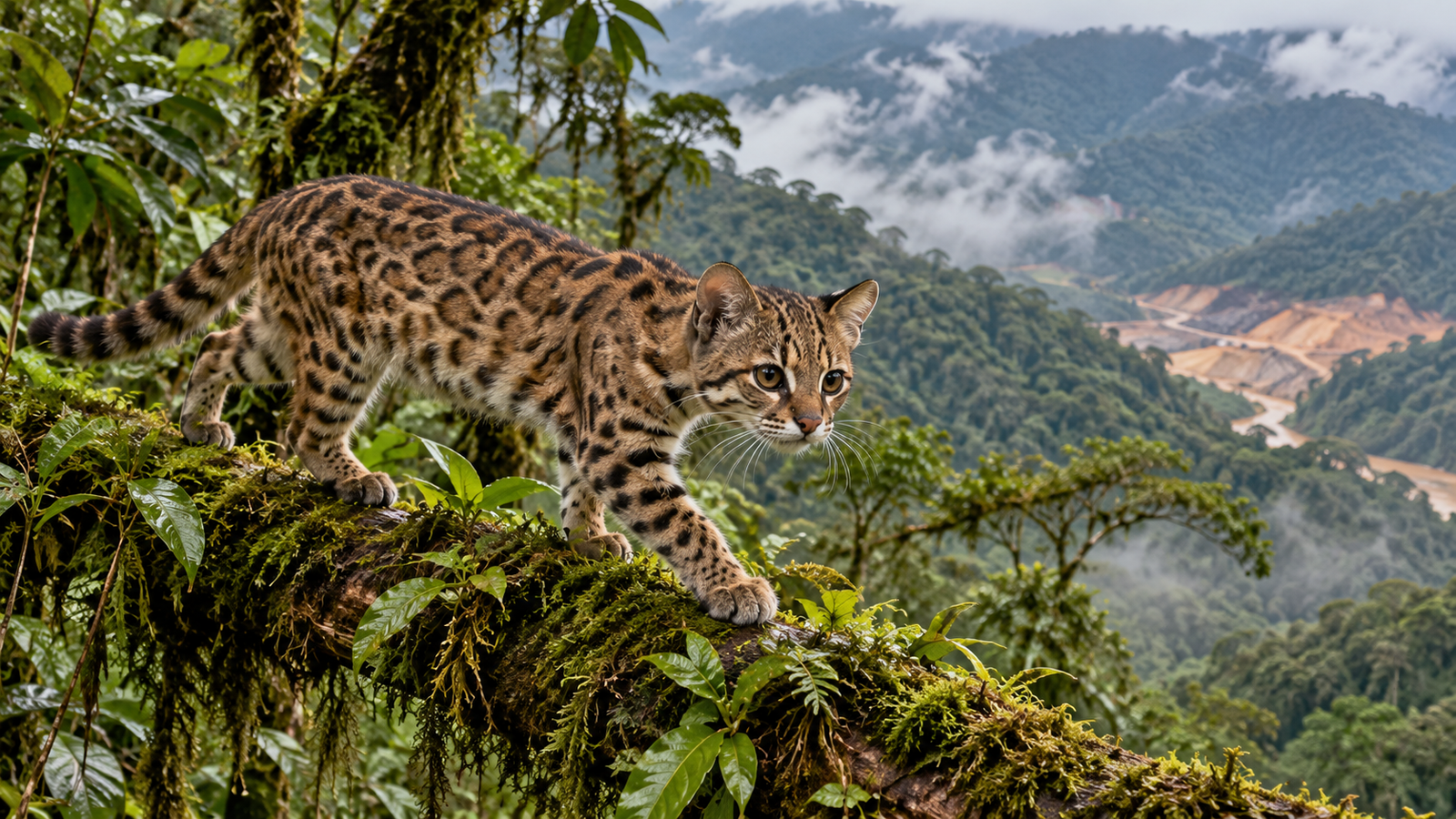
WWATV AI-generated editorial illustration—not documentary photography. It visualizes the exact animal and verified reporting context.
LIVING SPECIES DISCOVERY
The Tiny Wild Cat Science Nearly Missed
Leopardus tilcayo · Species described September 17; habitat follow-up October 16, 2026
The first newly named living cat species in more than a century is smaller than a house cat—and its Bolivian cloud-forest home is already under pressure.
The “weird cat” at a sanctuary
In Bolivia’s Yungas cloud forest, local people already had a name for a small spotted feline: tilcayo. Science did not yet understand that it represented a distinct species. The trail began when a family found a kitten, tried to keep it as a pet and later brought it to the Senda Verde Wildlife Sanctuary.
Bolivian biologist Paola Nogales-Ascarrunz was asked to examine the unusual cat. It was smaller than a typical house cat, with a light brown coat and irregular rosettes. Photographs suggested that it did not neatly match the other tiger cats researchers knew.
A new living cat species
On September 17, 2026, researchers formally described Leopardus tilcayo in Current Biology. It was the first newly named living cat species in more than a century.
The name respects the word used by communities in the Bolivian Yungas. That matters: the animal was new to formal science, not necessarily new to the people who shared its forest.
How the team proved it
Appearance alone could not establish a new species. Researchers combined genomics—the comparison of DNA across the genome—with museum evidence, anatomy, geography and evolutionary analysis. Their study resolved five distinct South American tiger-cat species and also described a new Peruvian subspecies.
The tilcayo lineage was genetically and anatomically distinct. Scientists estimate it separated from its closest relatives millions of years ago. Only two live individuals formed the foundation of the description: a female treated for injuries and released, and a male now living at the sanctuary because it had become habituated to people.
A home under pressure
The discovery immediately created a conservation question: how many tilcayos remain in the wild, and how much habitat do they occupy? Their confirmed home is the Yungas, a steep, wet band of cloud forest on the eastern Andes.
Reporting published October 16 drew attention to gold mining near this newly recognized cat’s habitat. Forest clearing, roads, pollution and human expansion can fragment the very landscape researchers are only beginning to map.
Discovery is the beginning
Naming a species does not complete its story. Scientists still need field surveys, camera traps, genetic samples and community knowledge to estimate its range, population and ecological needs.
The tilcayo is a reminder that discovery can happen in plain sight—and that recognition may arrive at the same moment a species needs protection. The next chapter depends on careful research in the forest and partnership with the people who knew the animal’s name before science did.
Explore Tilcayo cat in Learn & Grow
Reporting credit: Current Biology, DOI 10.1016/j.cub.2026.08.059; October 16 habitat follow-up by El País América Futura.