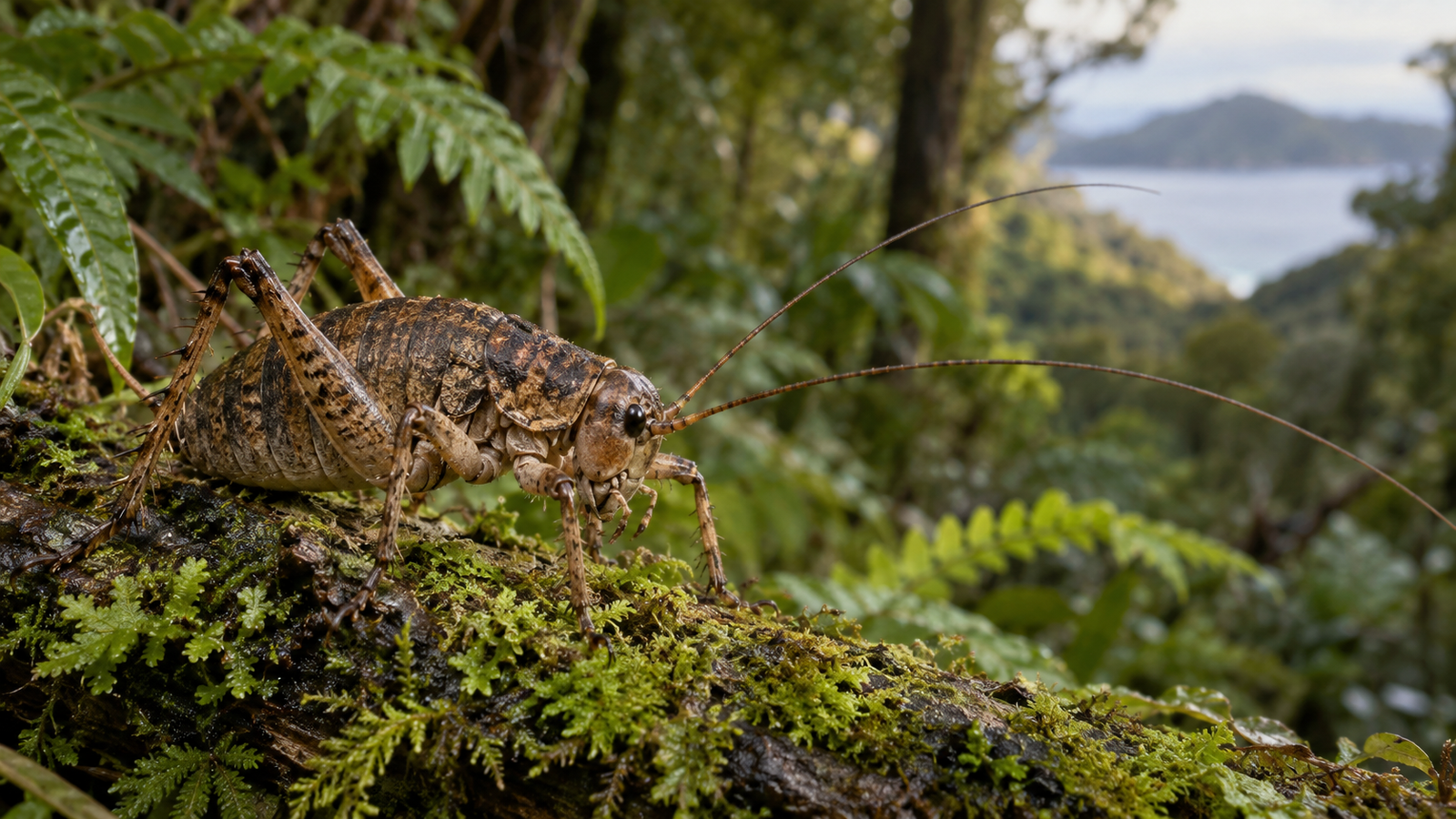
WWATV AI-generated editorial illustration—not a photograph of the reported event or research. It visualizes the exact species and verified story context without claiming documentary evidence.
CONSERVATION RECOVERY
How New Zealand’s Giant Wētā Came Back From One Island
Deinacrida heteracantha · Research first published September 9; DOC report October 2, 2026
More than 11,000 animals were released across a carefully managed recovery program—but the strongest evidence is not a release count. It is the appearance of fourth- and fifth-generation descendants at two protected island sites.
The survivor in the leaves
After dark in a New Zealand forest, a giant insect begins to move among leaves and branches. It cannot fly. It is heavy for an insect, slow compared with many of its smaller relatives, and vulnerable to mammals that never belonged in its world. Yet the wētāpunga has become the center of one of the most ambitious invertebrate recovery programs ever attempted in Aotearoa New Zealand.
Wētāpunga means “god of ugly things,” but there is nothing ordinary about it. Deinacrida heteracantha is New Zealand’s largest giant wētā and is often described as the world’s heaviest orthopteran—the insect order that includes crickets, grasshoppers and katydids. Its size makes it unforgettable. Its recovery story makes it important.
For decades, the species was reduced to a single natural refuge: Te Hauturu-o-Toi, also known as Little Barrier Island. Habitat loss had erased much of its former range across northern New Zealand. Introduced mammals—including rats, stoats and cats—added a danger that a large, flightless, nocturnal insect had not evolved to escape.
By the 1990s, conservation planners recognized that one island population was not enough. A storm, disease event, new predator incursion or other disaster could place the entire species at risk. The long-term goal was therefore bigger than protecting a remnant. Wētāpunga needed several secure wild populations.
Why conservationists did not simply move them
Direct translocation sounds simple: find animals on the source island, move them to predator-free habitat, and let a new population grow. The problem was numbers. Surveys between 2005 and 2009 found too few wētāpunga to remove large groups safely from the only surviving natural population.
The recovery team chose a more careful path. Instead of taking enough wild insects to stock every release site, it collected small founder groups and established conservation-breeding colonies. Butterfly Creek began the first colony with six adults in December 2008, followed by carefully balanced groups in later years. Auckland Zoo established another colony in 2012.
This was not mass production in the usual sense. The breeding rooms had to mimic seasonal light and temperature. Humidity had to remain high enough for the insects but low enough to reduce fungal problems. Females needed moist soil for laying eggs. Young wētāpunga required enough enclosure height to molt successfully, along with native foliage, leaf litter, protein, water and places to hide.
The program also had to protect genetic representation. Eggs and young were tracked so that releases did not descend from only a few successful mothers. Males and females were paired deliberately. Small improvements in housing and communal rearing later allowed the teams to raise many more animals while retaining careful oversight.
Eleven thousand chances to begin again
The result was extraordinary in scale. Beginning in 2010, the breeding program produced more than 11,000 wētāpunga for release. Across 45 translocations, teams founded ten populations: eight on predator-free islands and two inside predator-proof fenced sanctuaries on the mainland.
Auckland Zoo alone bred and released 8,874 wētāpunga from 2014 through 2025, according to the Department of Conservation. That number is impressive, but releases are not the true measure of recovery. Conservation success depends on what happens after the transport boxes are opened.
On Motuora and Tiritiri Matangi islands, intensive monitoring has found animals born four or five generations after the original releases. That matters because persistence across generations is stronger evidence than a few surviving founders. It shows that animals are reproducing in their new homes and that their descendants are doing the same.
The species’ national threat ranking has improved from Nationally Endangered at the start of the recovery effort to Nationally Increasing in the 2022 assessment. That is a major step forward, but it does not mean the wētāpunga is safe everywhere or that management can stop. New populations must remain protected from invasive predators. Their numbers and genetic health still need monitoring. The original Te Hauturu-o-Toi population remains irreplaceable.
Recovery built by many hands
This achievement was not the work of a single zoo or laboratory. Ngāti Manuhiri are mana whenua and kaitiaki of wētāpunga and Te Hauturu-o-Toi, and their continuing support and involvement are part of the program’s foundation. The Department of Conservation, Butterfly Creek, Auckland Zoo, island restoration groups, fenced-sanctuary teams, researchers, donors and volunteers each carried different parts of the work.
The recovery also shows why insects deserve the same seriousness often reserved for charismatic mammals. Invertebrate reintroductions are less frequently documented, and their success can be difficult to judge. The newly published research does more than celebrate wētāpunga. It records husbandry, release strategy and evidence of population persistence so other programs do not have to start from zero.
What to watch next
The next chapter is not another headline number. It is the continued survival of each new population. Researchers and local guardians will look for later generations, changing abundance, genetic diversity and signs that habitats remain secure. Some release sites have not yet had enough time to demonstrate the same multigenerational establishment seen on Motuora and Tiritiri Matangi.
The honest lesson is hopeful: recovery can work when people protect habitat, remove the predators that caused decline, learn how to breed a difficult species, and stay involved long enough to measure what happens after release.
The wētāpunga did not return because one dramatic rescue solved everything. It returned through thousands of small acts—misting enclosures, tracking parentage, carrying release containers, checking forest refuges, managing islands and repeating the work for more than fifteen years.
Explore Wētāpunga / Little Barrier giant wētā in Learn & Grow
Exact-species live encyclopedia entry verified October 14, 2026.
Reporting credit: Reporting based on the New Zealand Journal of Zoology recovery paper and the New Zealand Department of Conservation.